
How to build a multifamily marketing budget for the year ahead
Jul 15, 2026

Budget season has a way of sneaking up on you. One minute it’s a lazy summer afternoon, the next you’re being asked to commit real dollars to next year’s marketing before anyone knows what next year looks like. For many multifamily owners and property management companies, budget season runs from late summer through fall, with the heaviest lift happening between August and October and approvals due before January.
Here’s the tricky part: Building a multifamily marketing budget means predicting the future with a straight face. Renter behavior shifts, search keeps evolving and the “safe” move — copying last year’s numbers and nudging them up a few percent — quietly locks you into last year’s assumptions.
A smart budget isn’t about guessing the future perfectly. It’s about using strategy and data to decide where your money should go so your bases are covered for the year ahead.
Start with strategy, not line items
The fastest way to build a weak budget is to open last year’s spreadsheet and start editing. It might feel efficient, but it bakes in every (possibly outdated) assumption you made 12 months ago.
A stronger approach is to zoom out and ask where value comes from before you assign a single dollar. One way to organize that thinking: Run every potential spend through four filters — where renters find you, what builds trust, what moves them forward and how you’ll measure performance.
- Sources: Where do your highest-value leads begin? Organic search, AI-powered search experiences, your Google Business Profile, ILSs, paid search, reviews and social media all deserve a look. Check the data, then fund the ones that consistently bring you high-intent leads.
- Signals: What do renters and search engines look for? Professional visual media, clear website content, fresh blogs and authentic reviews all signal that a community is real, active and worth touring.
- Touchpoints: Which interactions move a renter forward? Chat and AI assistants, cost calculators and floor plan tools reduce uncertainty and keep people moving toward a lease. Are these touchpoints represented in your budget?
- Data: What will tell you whether any of this worked? Budget for analytics that measure decisions, not just activity.
When you run your spending through those four filters, some line items start to justify themselves and others don’t.
Multifamily marketing costs: What to expect
Strategy is great, but at some point, everyone wants real numbers. This is where a worksheet like the one below comes in handy. It puts every marketing type in one place with an industry price range next to it, so you can see how your spend matches up.
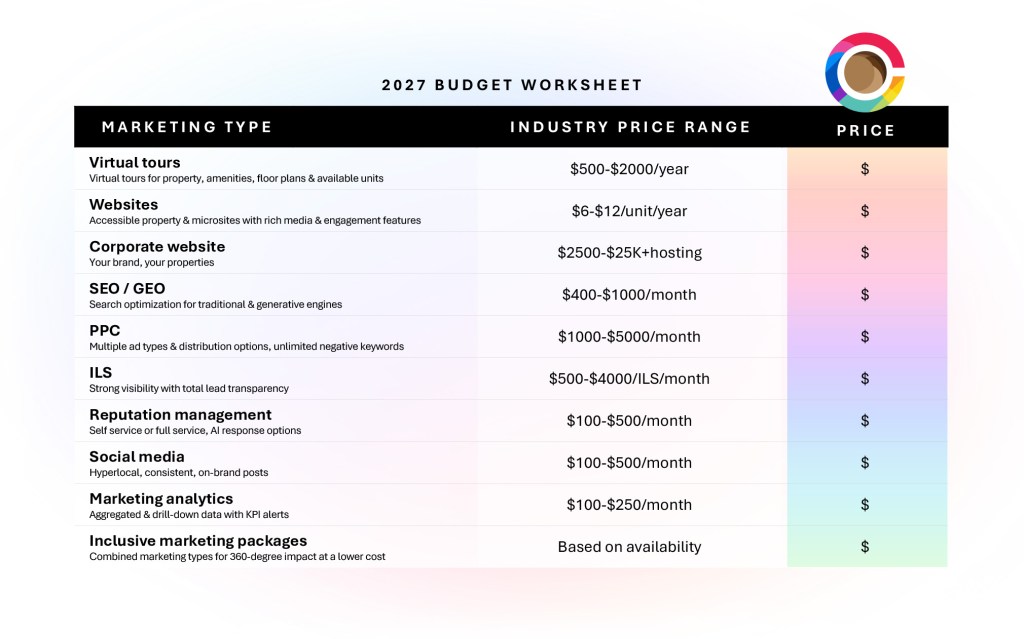
A few things tend to surprise people here. Ranges are wide — websites, SEO/GEO, PPC, ILSs, reputation management, social media and analytics all scale differently depending on your portfolio size and mix. A price that fits a 40-unit community looks different than one for a 40,000-unit portfolio. You can get a simple website for $2,500 or a completely custom one that costs $25,000 or more.
This is why a shortcut like “just budget 3% of revenue” tends to let you down. A single percentage assumes every property spends the same way, but a lease-up in a competitive metro needs a different mix than a stabilized community with a waitlist. Rather than starting from one number and dividing it up, build the other direction. Price each marketing type your strategy calls for, add them up and let that total tell you what the right number is for your portfolio.
Once you have a total, look at how it breaks down. This is your share of wallet — how your spend is divided across types and channels. It’s a useful frame of reference. For example, if 80% of your budget is going to one channel, is that where 80% of your results come from? If not, the breakdown tells you where to rebalance.
Cost vs. value: What to prioritize & why
The cheapest option in each category is rarely the one that saves you money. A few things worth weighing before you commit:
- Websites work best when they’re built to connect with your property management system. They reduce interface headaches, create a better user experience and include schema markup that helps traditional and AI search engines understand your site. RentCafe websites include this schema markup out of the box.
- SEO and GEO have quietly changed. Search now includes optimizing for AI and generative engines, so “just rank for keywords” is yesterday’s playbook. Look for providers with real expertise in AI visibility.
- Virtual tours are only as valuable as their reach. Prioritize broad syndication to ILSs, your Google Business Profile and other platforms.
- Reputation management should let you benchmark against competitors and give on-site teams an easy way to respond to reviews.
- Marketing analytics should go beyond basic source reporting into multisource models, journey transparency and KPI alerts that prompt action. These will help you make next year’s marketing budget decisions.
- All-in-one multifamily marketing packages like REACH 360 can lower costs across the board and help you cover the AI-search touchpoints that are easy to miss when you buy piecemeal.
The theme: Spend on what performs, not just what’s inexpensive today.
Build a multifamily marketing budget you can defend
A good multifamily marketing budget isn’t the one with the smallest or biggest number. It’s the one you can defend — to your CFO, your owners and yourself — because every dollar is tied to where value comes from. Start with strategy, ground it in real ranges and buy for performance.
If you’d rather not build it from guesswork, our team can help. Request a REACH budget consultation, and we’ll fill in real pricing based on your portfolio and needs. You’ll walk into budget season with numbers you can use with confidence … guaranteed through January 15, 2027.
Read next: 4 ways to rethink your budget for AI search
Frequently asked questions
For most multifamily companies, budget season runs late summer through fall, with approvals due before January 1. Starting early gives you room to think strategically rather than rush to fit last year’s template.
Share of wallet describes how your total marketing spend is distributed across different types and channels. Looking at it helps you spot when you’re over-invested in one area and under-invested in another, relative to where your results come from.
There’s no universal percentage. The right number depends on portfolio size, unit mix, occupancy goals and your market. That’s why building from a worksheet that’s tied to strategy beats applying a flat percentage across the board.
Not automatically. Slow seasons are often exactly when visibility matters most. Instead of cutting across the board, reallocate toward the sources and touchpoints proven to drive the most leads and leases.
Yes. Renters and AI tools increasingly discover communities through generative search experiences. Budgeting for GEO and AI-ready assets now protects your visibility as more of the search journey shifts in that direction.

Recent posts

Rental search has changed. Here’s how you should update your SEO and PPC strategies to stay visible in the AI era.

Explore this updated guide to generative engine optimization and find out what you need to know as an apartment marketer.

Adapt your apartment website content for AI search without hurting your SEO. Boost AI citations with 5 practical updates to structure, specificity and FAQs.
Categories
Similar articles

4 ways to rethink your marketing budget for AI search
If you already read “How to build a multifamily marketing budget,” you know that building next year’s marketing budget isn’t…

Apartment marketing series: Fresh website, budget, search & PPC strategies to use now
Join this fun, fast-paced series with our favorite experts. It’s apartment marketing insights you can’t get anywhere else! Attend all the sessions or just one, it’s up to you.

REACH 360: A closer look at the next big thing in search
Reach renters wherever they search with a multimedia, multichannel solution. REACH 360 includes five powerful marketing tools for the AI era and beyond.